
Anthracite
High-carbon anthracite filter medium made from hard, durable grains. Used as the top (lighter) layer above silica sand in dual-media filters. Compliant with EN 12909.
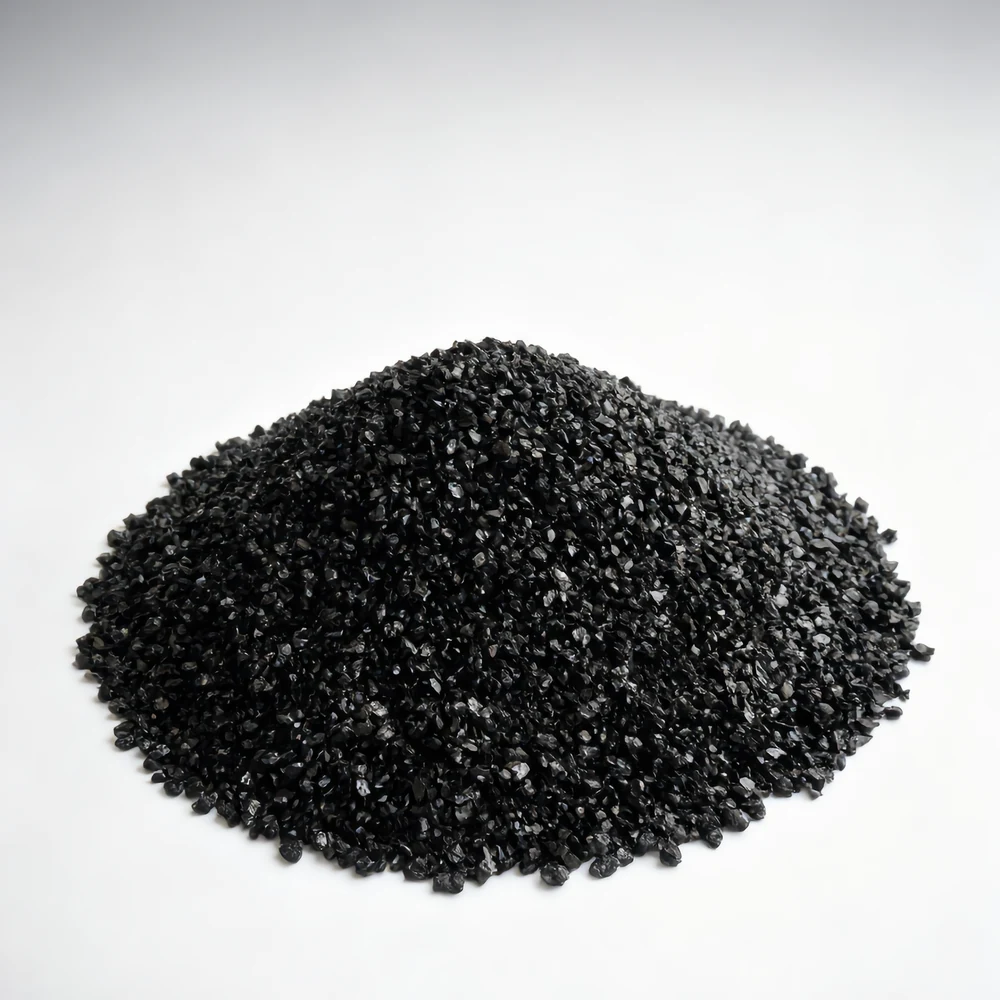
What is Anthracite?
Anthracite is a high-carbon filter medium made from hard, durable grains that forms the top layer of dual-media filters in drinking-water, wastewater and process treatment plants. Thanks to its low density and high carbon content, when used together with silica sand it delivers deep-bed filtration and long filter cycles. It is compliant with EN 12909.
Anthracite is a natural filter medium processed from premium anthracite coal and freed of iron sulphide, clay, shale and dust. Its typical carbon content is ≈92%, moisture ≈2%, ash ≈5% and volatile matter ≈6%, with an acid solubility below 2%. With an effective grain size (d₁₀) of 0.9–1.0 mm and a uniformity coefficient ≤1.4, the product is supplied in a 0.8–1.6 mm grain range. With a bulk density of ≈700 kg/m³ and a Mohs hardness of 3–4, the anthracite provides minimal media loss with very low abrasion loss of ≈0.1% over backwashing.
Technical summary & chemistry
Values are typical batch figures; a current batch analysis report is provided with each shipment.
Technical Summary
- Grain size
- 0.8–1.6 mm
- Certificate
- EN 12909
Chemical Composition
- Carbon (dry, ash-free)
- ≈ 92%
- Moisture
- ≈ 2%
- Ash
- ≈ 5%
- Volatile matter
- ≈ 6%
- Acid solubility (19% HCl)
- maks. 2%
- Hardness (Mohs)
- Mohs 3–4
Additional Technical Properties
- Efektif tane boyutu (d₁₀)
- 0,9–1,0 mm
- Üniformite katsayısı
- ≤ 1,4
- Yığın yoğunluğu
- ≈ 700 kg/m³
- Özgül yoğunluk
- 1,35–1,6 kg/cm³
- Tane gözenekliliği
- < %10
- Aşınma kaybı (100 geri yıkama)
- ≈ %0,1
- Alt boyut (< 0,8 mm)
- maks. %5
- Üst boyut (> 1,6 mm)
- maks. %5
Fractions & sieve analysis
Produced in 4 controlled gradations; grain ranges are listed for each fraction below.
Fraction
4 fractionsWhere is it used?
Thanks to its low density it sits above the silica sand, offering the dual-media filtration advantage in removing insoluble clay, mud and sediment as well as oxidised iron and manganese.
In drinking-water and wastewater treatment it extends filter cycles and reduces pressure loss.
Its coarse, porous structure carries particles deep into the bed, increasing retention capacity.
About Anthracite
What is anthracite used for?
It is used in the top layer of dual-media filters; thanks to its low density it stays above the silica sand and provides deep filtration in removing clay, mud, sediment and oxidised iron/manganese.
What is the carbon content of anthracite?
Our product has a typical fixed carbon content of about 92% and is compliant with EN 12909.
Why are anthracite and silica sand used together?
The lighter anthracite sits on top and the heavier silica sand below, forming a dual-media filtration bed; this structure increases retention capacity and filter cycle time.
What is the uniformity coefficient of anthracite?
The uniformity coefficient is ≤1.4 and the effective grain size (d₁₀) is 0.9–1.0 mm. These values provide a balanced, efficient filter bed.
What can you rely on?
Batch-based analysis
Grain size and chemical composition are reported with every shipment.
Consistent quality
Production at our own facility; consistent batch-to-batch results.
Flexible packaging
Bulk, big-bag or sack — delivered to suit your requirement.
Free sample
We provide a sample and technical support before you decide.
Consider together
Get a quote for Anthracite
Tell us what you need; we will get back to you quickly with the right grain size, packaging and shipping.